Types of Skin Cancer New York, NY

Types of Skin Cancer

Skin cancer is the most common form of cancer in the United States. More than 500,000 new cases are reported each year – and the incidence is rising faster than any other type of cancer. Anyone can get skin cancer – no matter what your skin type, race, or age, no matter where you live or what you do. Though skin cancers can be found on any part of the body, 80 percent appear on the face, head, or neck, where they may be disfiguring as well as dangerous.

Fortunately, most skin cancers can be removed by plastic surgeons. If the cancer is small, the procedure usually can be performed quickly and easily in your doctor’s office or in an outpatient facility. In many cases, the resulting scar will be barely visible, or will be concealed within the natural folds and contours of your face.

Cancer of any sort is frightening to most patients, but when it carries with it the possibility of scarring and disfiguration, the patient is apt to be particularly apprehensive and even depressed. Cure is the primary goal of treatment for any skin cancer, but all parties to the treatment planning should be sensitive to the patient’s desire to emerge with an appearance that is as aesthetically appealing as possible. Early consultation with a knowledgeable plastic surgeon makes good sense even if the primary care physician ultimately undertakes the treatment. Together, the primary care physician and the plastic surgeon can develop appropriate options for the patient to consider.

cancer treatment intro

Epidemiology and Etiology of Skin Cancer

Cancer of the skin is generally divided into two broad categories: melanoma and nonmelanoma cancers. Nonmelanoma cancers account for about 80 percent of skin malignancies. The most common nonmelanoma cancers are Basal Cell Carcinoma (BCC) and Squamous Cell Carcinoma (SCC), but other tumors of sweat glands, hair follicles, or virtually any other structure of the skin may also be included.

Some estimates suggest that up to half of all Americans who reach the age of 65 will have some type of skin cancer at least once. The lifetime probability of developing a skin malignancy varies by sex, geographic area of residence, and cancer type. Risk factors for cancer of the skin include:

  • Exposure to ultraviolet radiation (this includes tanning beds and tanning lamps, as well as sunlight)
  • Residence in so-called “sunbelt” areas, i.e., latitudes closer to the equator
  • Dysplastic nevi
  • Family history/genetic anomalies
  • History of severe sunburn
  • Fair skin
  • History of x-ray or radiation burns
  • Occupational exposure to coal tar, pitch, creosote, arsenic compounds, or radium
  • Immunocompromised status

Exposure to ultraviolet radiation from the sun is a major risk factor for all the principal types of skin cancer. Persons at greatest risk are those with fair skin, light hair, light eyes, and the genetic phenotype most susceptible to sunburn. Living closer to the equator increases the risk, as does participation in outdoor activities. However, the specific risk varies with the type of cancer.

Epidemiologic data suggest that the risk of developing Malignant Melanoma (MM) is specifically related to the amount and intensity of sun exposure during adolescence. A person who experienced three or more severe, blistering sunburns during those years has a risk of developing MM four to five times greater than that of the general population.

Individuals whose sun exposure is sporadic summertime trips to the beach for example, have a greater risk for MM, but people whose exposure to sun is constant, such as farmers or road-construction workers, are more at risk for BCC or SCC. Malignant tumors of all types may also develop years after x-ray or radium burns or occupational exposure to coal tar, pitch, creosote, arsenic compounds, or radium.

Xeroderma pigmentosum is a rare, chronic, progressive, pigmentary and atrophic disease. It is inherited as an autosomal recessive trait involving a defect in the enzymes active in the excision and repair of DNA damaged by ultraviolet radiation. In this disease, the eyes and skin are extremely sensitive to light. Xeroderma pigmentosum begins in childhood, and early development includes a number of serious problems, among which might be melanoma, BCC, or SCC. Patients with this disease have about a three-fold increased risk of developing some type of skin cancer.

African Americans and others with dark skin rarely develop skin cancer, but when it does occur, it most commonly develops under the fingernails or toenails or on the soles or palms. Risk factors include exposure to sunlight, albinism, burn scars, preexisting pigmented lesions, and chronic discoid lupus erythematosus.

Although most skin cancers can be removed surgically, your specific treatment will depend on the type of cancer you have, its stage of growth, and its location on your body. Skin cancer is diagnosed by removing all or part of the growth and examining its cells under a microscope. Plastic surgeons treat all of the following types of skin cancers:

Basal Cell Carcinoma

Basal cell carcinoma accounts for more than 90 percent of all skin cancers in the United States. The lifetime probability of developing BCC is 11 to 28 percent. The risk is similar for males and females when they are young, but after the age of 45, men are more likely to develop BCC than women (male/female age adjusted incidence ratio =1.6).

Areas that are exposed – the head, face and neck, arms and hands – are the most common sites for BCC, with the tumor often arising on the nose. Basal cell carcinomas are slow-growing and rarely metastasize, but they can invade or impinge upon underlying orifices (e.g., eyes, ears, mouth) or structures (e.g., bone, dura mater).

Your Plastic Surgeon Can Treat Other Types of Skin Growths as Well

Moles

These growths appear as clusters of heavily pigmented skin cells that may be flat or raised above the skin’s surface. While most pose no danger, some may develop into malignant melanoma, particularly those that have mottled colors or irregular edges. Often, moles are removed for cosmetic reasons or because they’re constantly irritated from rubbing against clothing and jewelry (which can sometimes cause pre-cancerous changes).

Keratosis

These rough red or brown patches on the skin are usually found on areas exposed to the sun. They sometimes develop into squamous cell cancer.

Kaposi’s Sarcoma

Kaposi’s sarcoma (KS) once occurred mainly in an indolent form in men of Italian or Jewish ancestry over the age of 60 years. Today, however, KS is the most common neoplastic process in patients with HIV. Kaposi’s sarcoma appears in an aggressive, disseminated form in at least one-third of patients with AIDS.

In older men, KS usually appears first on the toes or legs as purple or brown plaques or nodules that may penetrate soft tissue or bone. In five to 10 percent of cases, there is dissemination to lymph nodes or viscera. In patients with HIV infection, the KS lesions may be the first manifestations of AIDS. Up to 80 percent of patients with AIDS and KS lesions involving head and neck structures are asymptomatic. The first lesions appear primarily on the upper body or mucosa as slightly elevated pink or red papules. As the disease progresses, the lesions become widely disseminated in the skin, mucous membranes, lymph nodes, and viscera.

Dr Antell consulting with patient walking together in modern medical office hallway - in New York, NY

How to Get Started?


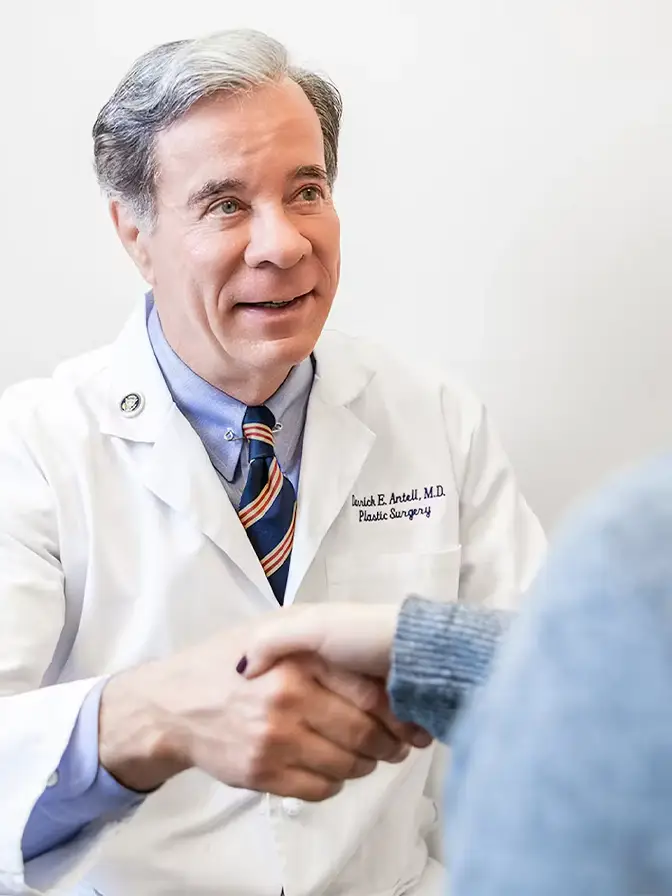
Dr. Darrick E. Antell and his staff will be happy to discuss Types of Skin Cancer with you.  Please call for a private consultation or schedule an appointment online at our office.


Schedule a Consultation

In-Office & Virtual Consultations with Dr. Antell are Available

Location New York, NY
5 Stars 418 Reviews